The time we spend on social media

The time we spend on social media
Absence from work continues to be a massive headache for most employers. To ensure productivity and economic viability of a business, most employers tend to focus exclusively on traditional timekeeping offences such a reporting late for duty or being absent altogether.
“Present absenteeism” is however overlooked and may pose a bigger threat to a business compared to traditional timekeeping offences. “Present absenteeism” can be best described as instances where an employee is at work but absent in terms of the requirement of having to work. Such may include taking unscheduled breaks, leaving one’s workstation, and attending to private matters during working hours.
Due to technology, changing trends in social interaction and a younger generation of employees, most employers overlook the impact that social media may have on a business, whether it be negative or utilized in a positive manner.
Digitalportal.com is a leading social media trends research institution and recently published some interesting, possibly even shocking statistics pertaining to social media use worldwide with South Africa again taking silver in the category of spending the most time per day on social media.
2024/02
By Simon Kemp from Digitalportal.com (www.digitalportal.com)
It’s official: we spend a lot of time using social media. But exactly how much time is “a lot”?
The “typical” internet user spends almost 2½ hours each day using social media platforms, equating to more than one-third of our total online time. TikTok has the highest average time per user, but YouTube accounts for the greatest overall share of total social media time.
Research from GWI reveals that the “typical” social media user now spends 2 hours and 23 minutes per day using social platforms.

On average, that means that social media accounts for 35.8 percent of our daily online activities, meaning that more than 1 in 3 internet minutes can be attributed to social media platforms.
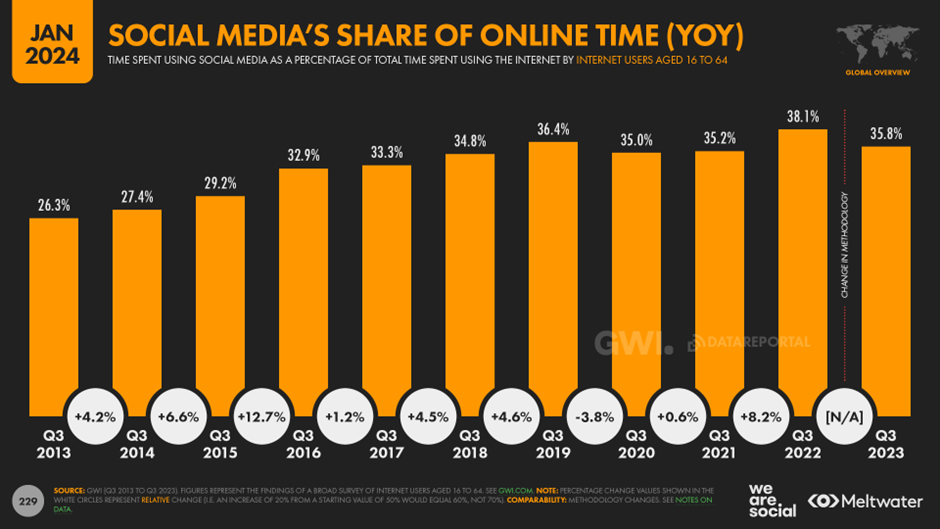
These stats are already quite impressive, but let’s put all of this social media activity into context.
Our latest analysis reveals that there are now 5.04 billion active social media user “identities” in the world, and while this figure may not represent unique individuals, it’s still a representative figure for overall social media use.
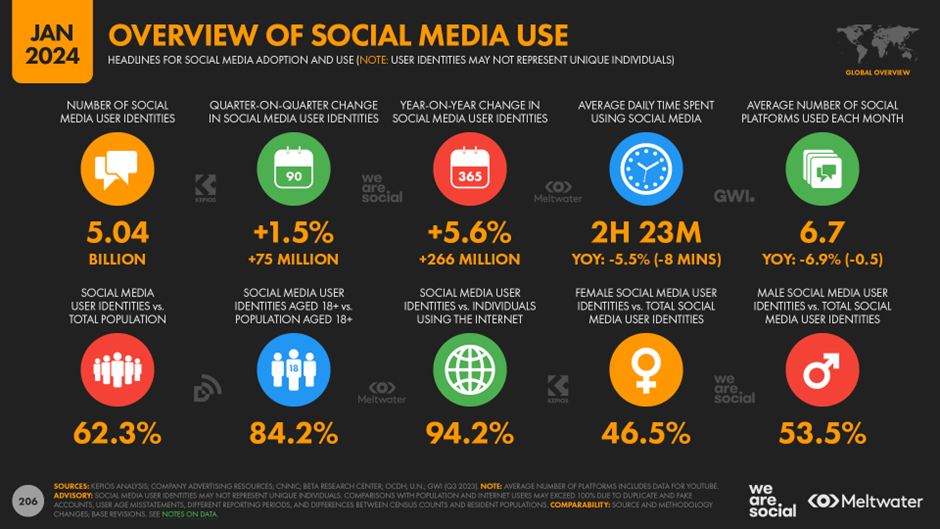
Similarly, it’s important to highlight that GWI’s data only quantifies the social media activity of internet users aged 16 to 64 in 53 of the world’s largest economies.
However, given that these 53 countries account for roughly 87 percent of all the world’s internet users, it’s safe to assume that they’re broadly representative of the vast majority of the world’s social media users.
So, caveats aside, how much time do the world’s 5 billion social media users spend on social media activities?
Well, at an average of 143 minutes per day, per user, the world spends 720 billion minutes per day using social platforms.
Over a full year, that adds up to more than 260 trillion minutes, or 500 million years of collective human time.
Social media use by age and gender
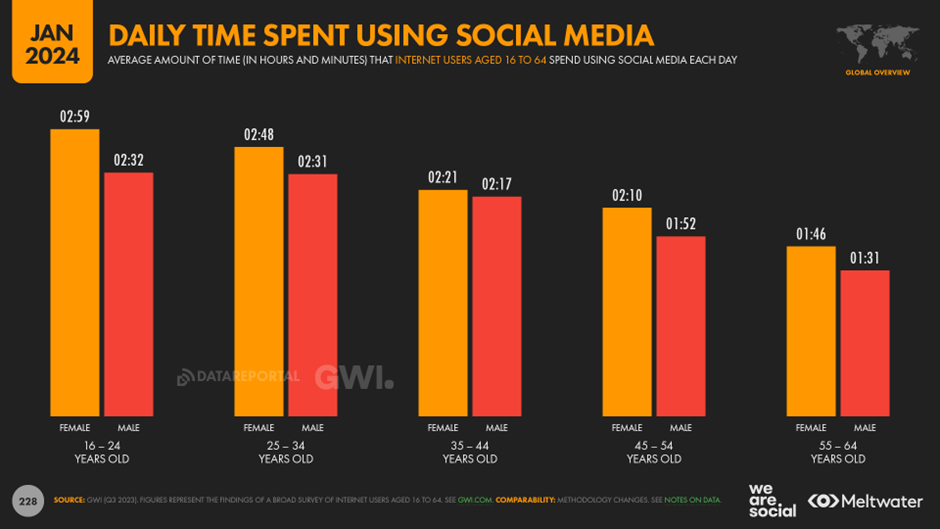
As you might expect though, social media use varies meaningfully by age.
Amongst GWI’s survey respondents, women between the ages of 16 and 24 spend the greatest amount of time using social media, at an average of almost 3 hours per day.
That’s almost double the amount of time that men aged 55 to 64 spend using social platforms, with this cohort telling GWI that they spend an average of 1 hour and 31 minutes per day using social media.
On average, women spend 16 minutes per day more than men do using social media, meaning that women spend roughly 12 percent longer using social media compared with men.
Social media time by country
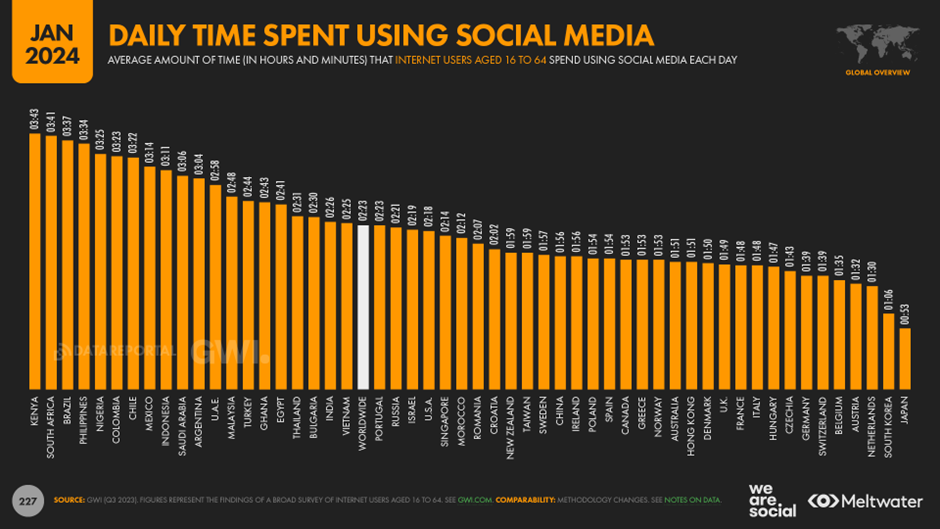
But we also see marked differences between countries when it comes to the time spent using social media.
At the top end of the scale, internet users in Kenya spend the most time using social media each day, at an average of 3 hours and 43 minutes per user.
South Africans rank second, with the typical user in the country spending 3 hours and 41 minutes per day on social platforms.
Brazil ranks third at 3 hours and 37 minutes, while Filipinos – once the “most social” nation in the world – slip to fourth in the latest rankings, at an average of 3 hours and 34 minutes per user, per day.
That’s still more than four times as long as the average Japanese person spends using social media though, with internet users in Japan saying that they spend an average of just 53 minutes per day on social platforms.
South Koreans also fall well below the global average, with the typical user in the country spending just 1 hour and 6 minutes per day on social media.
And it’s also interesting to note that Europeans tend to spend considerably less time on social media than their peers in Africa, Asia, and Latin America.
On average, people across the EU and UK spend just 1 hour and 48 minutes per day using social media, which is 35 minutes (24.5 percent) less than the global average.
Time spent on social platforms
Meanwhile, analysis from data.ai reveals that we spend more than one-third of our total mobile time using social media apps.
However, due to the nuances of app store categories, this figure does not include apps like TikTok and YouTube, which fall into the “entertainment” category rather than social media.
However, the good news is that data.ai Intelligence allows us to explore average time by app.
Total time
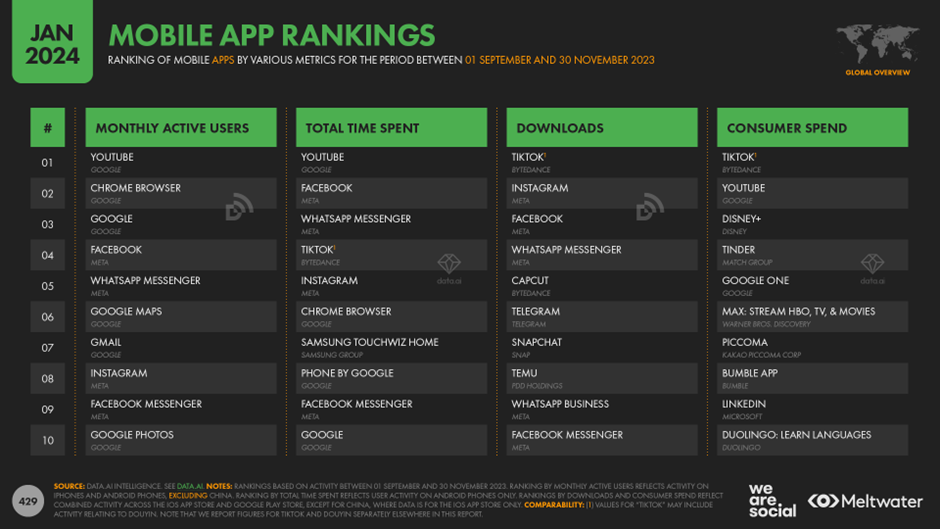
YouTube tops the ranking by total time spent, with the platform’s Android app users spending more than 10 trillion minutes per month watching YouTube videos.
For context, that means YouTube still commands more than twice as much total user time as TikTok, and 40 percent more time than Facebook.
WhatsApp also accounts for a significant amount of the world’s “social time” though, with the platform still well ahead of TikTok and Instagram in terms of total user time each month.
These figures are largely driven by each app’s total number of monthly active users, although – as we’ll see below – average time per user is also an important factor.
Average time per user
Interestingly, the rankings look quite different when we focus on average time per user.
Figures for the third quarter of 2023 show that TikTok now commands a commanding lead, with users spending an average of 34 hours per month using the platform’s Android app.
These findings suggest that the average user now spends more than an hour per day – every day – using TikTok.
However, data.ai’s figures also show that, on average, 61.7 percent of TikTok users open the app each day.
YouTube ranks second in terms of average time per user, with the platform’s Android app capturing 28 hours and 5 minutes per month, per user.
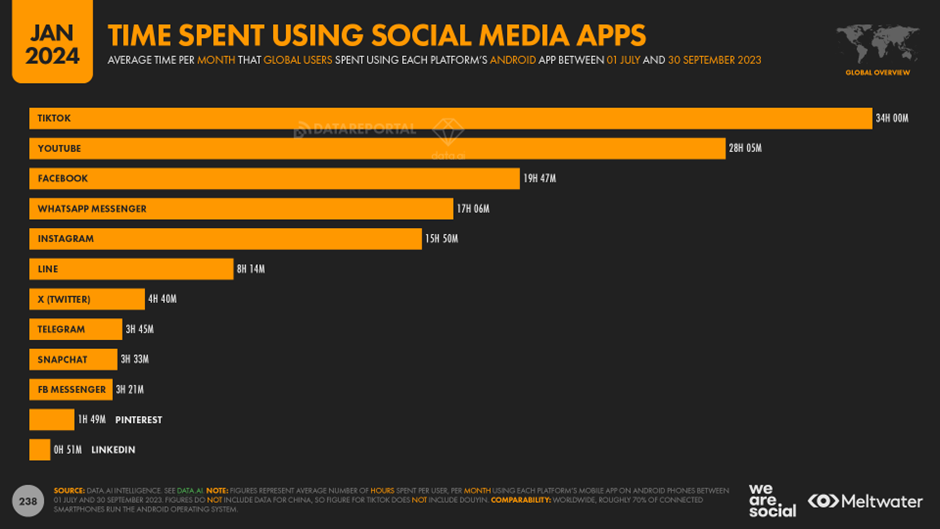
Figures for Facebook are a lot lower, but even at 19 hours and 47 minutes per month, Facebook still ranks third in terms of average time per user.
And once again, these figures demonstrate just how much misinformation there is in the media about Facebook’s enduring appeal around the world.
In other words, no – Facebook isn’t dying.
WhatsApp ranks fourth, with the world’s most popular messenger app capturing just over 17 hours per month, per user.
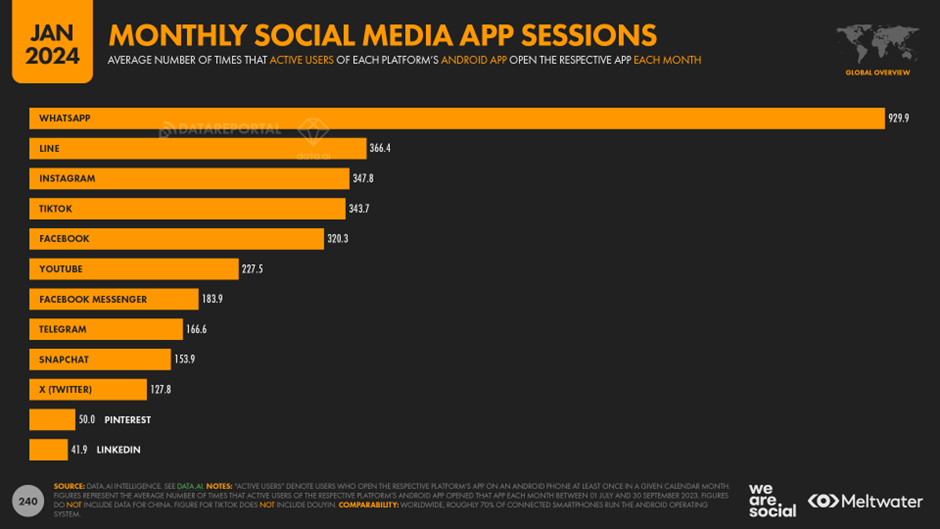
WhatsApp’s real strength lies in its average number of sessions though, with the app way out in front of its peers, at an average of almost 930 sessions per month, per user.
But perhaps the most surprising finding in the average time data is that Instagram ranks just fifth, with the typical user spending just under 16 hours per month using the platform’s Android app.
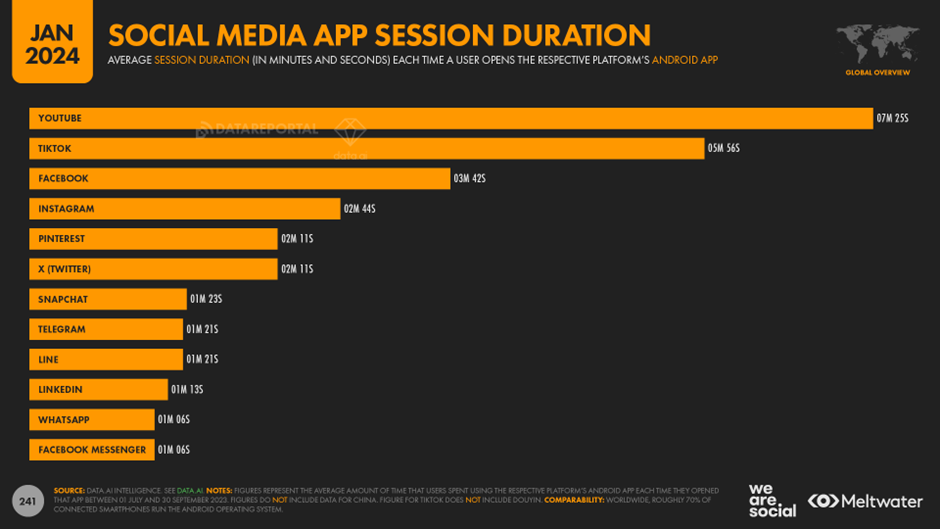
This may be partly due to the fact that the typical Instagram “session” lasts just 2 minutes and 44 seconds, which is considerably below the 7 minutes and 25 seconds per session enjoyed by YouTube, and the 5 minutes and 56 seconds for TikTok.
However, there is some better news for Instagram elsewhere in this year’s data, with GWI reporting that Instagram is now the world’s “favourite” social media platform.
Disclosure: Simon Kemp is a brand ambassador for both GWI and data.ai.
Article published with the kind courtesy of www.digitalportal.com.
This article does not constitute legal advice. For an informed opinion and/or assistance with a labour-related matter, you are encouraged to arrange a formal consultation with the author.
We will continue to keep you informed and updated.